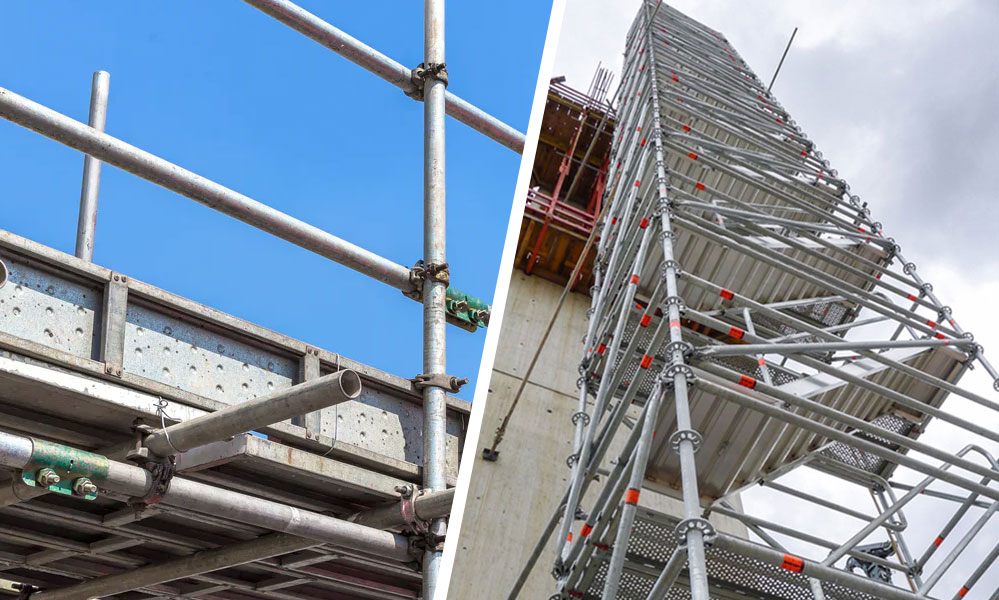
Most clients don’t actually want “scaffolding” — they want safe access that suits the job, the footprint, the programme and the risks. In 2026, the choice often comes down to two broad approaches: traditional tube & fitting, or a system scaffold solution. Both can be excellent. The best choice depends on what you’re building, where you’re working, and how fast the site needs to move.
Tube & fitting: maximum flexibility
Tube & fitting is the classic approach: tubes, couplers and boards built to match the building. Its strength is flexibility. It can deal with awkward shapes, restricted access, variations in façade, and the reality of older Scottish building stock where “straight lines” aren’t always a given.
It’s also well suited to bespoke solutions: bridging over entrances, integrating protection fans, complex loading needs, or unusual internal access.
System scaffolding: speed and consistency
System scaffolding uses standardised components designed to connect quickly and consistently. On projects with repetition (long runs, consistent bays, straightforward elevations), this can be very efficient. It also helps maintain uniform standards on busy sites where multiple lifts and access routes need to be kept consistent.
What really drives the decision on-site?
In practice, the “best” option is usually driven by a mix of:
Programme: how quickly you need access installed, adapted, and taken down.
Footprint: tight city-centre sites, tenements, and restricted pavements often need smarter planning.
Scope changes: refurbs can evolve; the more changeable the job, the more flexibility matters.
Protection: if you need edge protection, a temporary roof, debris control, or crash decks, the scaffold design needs to accommodate it from day one.
Compliance and peace of mind
Whichever approach is used, the key is that it’s designed, installed and managed properly. On commercial scaffolding jobs, clients want confidence that the scaffold solution aligns with recognised guidance and is being inspected and maintained as the site evolves. That’s where an experienced contractor adds value: not just building the scaffold, but planning safe access around the job’s constraints.
The simplest rule of thumb
If the job is complex, irregular, or likely to change, tube & fitting often wins on adaptability. If the job is repetitive and time-critical, system solutions often win on speed. Many real projects use a blend, especially when temporary roofs, edge protection, or specialist access is involved.