Scaffolding can carry a lot of weight. But not any weight, anywhere.
Every working platform has a load class, which tells you what it has been designed to carry. That includes the people standing on it, their tools and whatever materials they decide to bring up with them.
And that last bit matters.
A lot.
What do scaffold load classes actually mean?
Scaffold platforms are divided into load classes depending on the work they’re expected to handle.
Class 1 is at the light end, rated at 0.75 kN per square metre. It’s intended for inspection and very light work rather than storing materials.
Class 2 increases that to 1.5 kN/m².
Class 3 is where most of the everyday scaffolding M8 provide falls into. Class 3, which is rated at 2.0 kN/m², is generally used for normal construction work where trades need access, tools and reasonable amounts of materials on the platform.
Class 4 moves up to 3.0 kN/m².
There are heavier Classes 5 and 6 as well, but by this stage you’re dealing with scaffolding specifically intended for substantial loads.
You don’t just pile more stuff on.
The weight isn’t the whole story
We had a good example of this on one of our own jobs.
M8 had erected a Class 3 scaffold. The builder was working with large stone blocks, each weighing around 130kg.
One block was manageable.
Then three got stacked together.
That put roughly 390kg into one small area of the working platform rather than spreading the weight across it. A Class 3 scaffold has a uniformly distributed load rating of 2.0 kN/m², so where that weight sits matters just as much as the total amount sitting on the scaffold.
That’s the bit people can miss.
A few hundred kilos spread sensibly across a working area is one thing. Put the same weight into a small spot and you’ve changed what the scaffold is being asked to do.
Then add workers.
Add their equipment.
Suddenly the numbers aren’t quite so comfortable.
What if a scaffold gets overloaded?
You deal with it. Quickly.
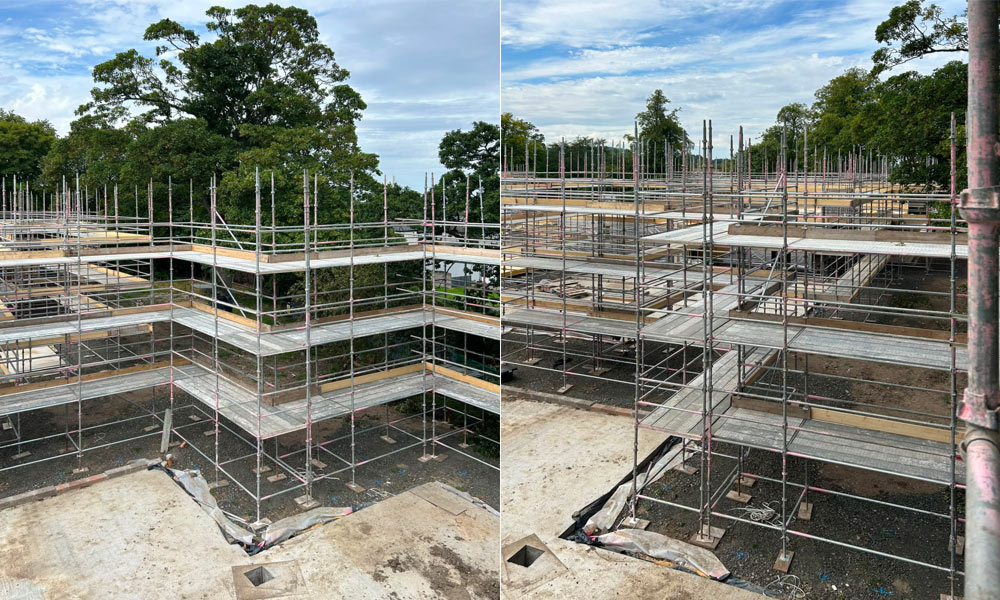
On this particular job, we built an additional scaffold beside the affected area so workers could access the site safely without relying on the overloaded section.
Heavy or badly positioned loads can put forces through parts of a scaffold that were never intended to take them. The platform itself is only part of the story because those forces eventually travel through the rest of the structure and its connections.
Could an overloaded scaffold collapse?
In an extreme situation, yes.
Nobody wants to find the limit by accident.
So if you’re going to load stone, blocks or other heavy materials onto a scaffold, tell us beforehand. We can make sure the scaffold is suitable for what you actually intend to do with it, rather than discovering halfway through the job that things have become considerably heavier than planned.